Who is Walter Mangold?
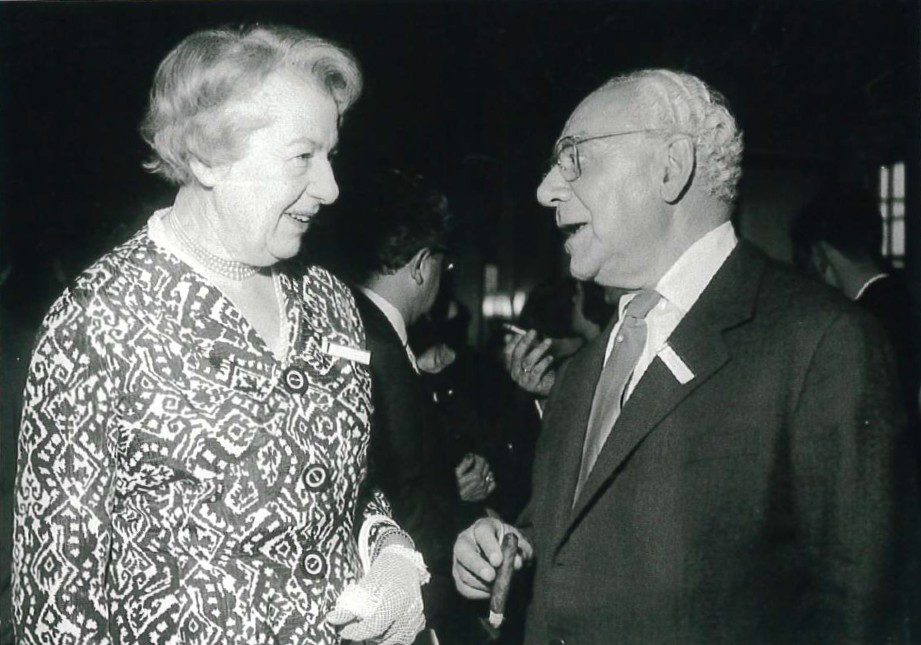
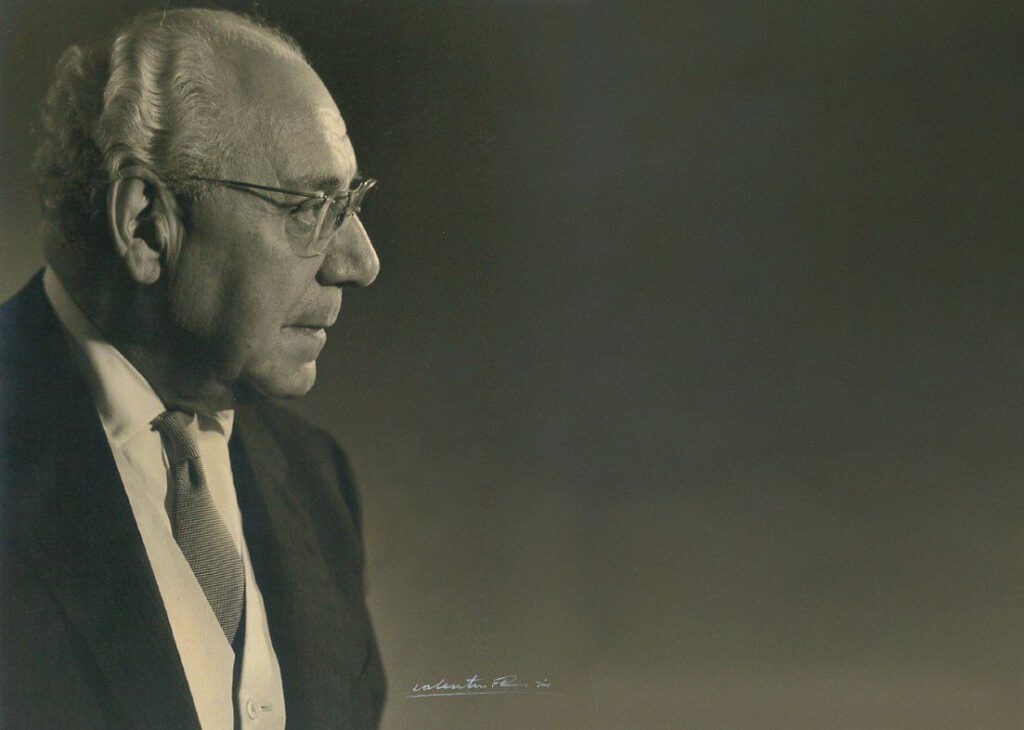
“I desire to place on record that a substantial portion of the assets available to me came from the estate of Walter Mangold. My late father, having experienced the devastations and hardships which the First World War, the Depression and the subsequent Second World War wrought on mankind, gave a great deal of thought to the causes of such upheavals. During the second half of his life he devoted his energies to the teaching of languages. He came to the conclusion that better understanding between peoples, and consequently lessening of conflict, could be achieved by improving communication between them.”
Anne Marie Herzenberg on Walter Mangold
Walter Mangold was born in Brunswick, Germany, in 1892 into an upper middle class Jewish family. Walter Mangold began his working life in Hannover, where he became a successful businessman, acting as an agent for Lyons Teas and other large international companies. His business was known as Mangold GMBH, and involved a great deal of travel. He married Irma Wolff and they had one daughter, Anne Marie, born in 1920. The family moved to Hamburg, where the family business was based. In 1933, Walter Mangold and his wife were divorced, and Walter Mangold, who was described by his daughter as ‘very eccentric’, continued to live and work in Hamburg. The family was not religious, and considered themselves as Germans who were Jewish, rather than the reverse.
Despite this belief, conditions for Jews in Germany during the 1930’s deteriorated rapidly, and by 1935 when race laws were introduced in Germany, Walter Mangold was taken to a concentration camp. He remained there for several years. Although knowledge of the details of his wartime history are vague, at some point he must have left or escaped from the German concentration camp, because it is known that he joined the French resistance movement, spent time in a French concentration camp from which he escaped, and made his way through the Pyrenees in winter to Spain, where he lived for the rest of his life.
Walter Mangold had strong intellectual abilities combined with a good business acumen, and he embraced many interests throughout his life. He had the ability to communicate and be at ease in any company, and spoke several languages. For a man of wealth, he lived modestly. When he was imprisoned in concentration camps, he was able to organise reading and discussion groups for his fellow prisoners, and was, like many people of his generation, extremely well educated in German classic literature. He had a reputation as a charming and very perceptive man, but one who could at times be difficult. He was also, through the power of his personality and his ability, able to make many contacts with influential people in Spain and elsewhere.
After the conclusion of the war, having no money, Walter Mangold rented a small room in Madrid, and began teaching English and other languages. At that time there was a strong demand for language teaching, and the school, known as the Mangold Institute, developed and expanded quickly. Teachers were brought in from other countries to meet the demand. At its peak the school had over 3,000 pupils. Walter Mangold had firm ideas about the teaching of language, and wrote his own textbooks, which led to establishment of his publishing firm, Editorial Mangold. The philosophy and aim of the school was to use the teaching of modern languages to improve communication between people and bring about better understanding between them.
Both businesses were very successful, but were eventually sold as Walter Mangold became older. He continued to be active in his retirement, and died on 18 October 1983, aged 91, a Spanish citizen.
Walter Mangold’s daughter, Anne Marie, followed a different path to her father. Because of the restrictions on Jews in the 1930’s, she was unable to continue her schooling, and worked for a time in a dress shop. She married her first husband, Hans Bergheim, in Germany in 1938 when she was 18, and they immediately left to live in Shanghai, escaping from Germany whilst they could still do so. They remained in Shanghai throughout World War 2, but in 1945 they decided to move to Australia. Hans Bergheim had a cousin living in Melbourne, and initially they planned to stay with them. However, Hans Bergheim became ill with heart disease whilst still in Shanghai, and he died three months after arriving in Sydney. Anne Marie, on her own, moved to Melbourne to stay with her first husband’s cousins, and settled in Melbourne for the rest of her life. She met and married Erwin Herzenberg, a fellow German and Jew, who had, like her, fled Germany before the war and come to Australia.
In 1952, when Anne Marie Herzenberg learned, quite by coincidence, that her father was still alive she contacted him in Spain and after that time they met frequently. In Melbourne, Anne Marie completed a Bachelor of Arts degree at The University of Melbourne, and a Diploma of Education at Monash University, and became a secondary school teacher until her retirement. Her husband Erwin was a chemical engineer, and together they maintained an active social life in Melbourne and made many friends. They had no children, and as both Erwin and Anne Marie were only children themselves, they had no immediate family at all. Erwin’s parents had died in the Holocaust, along with other family members.
Erwin Herzenberg died on 21 October 2002, and Anne Marie Herzenberg died on 13 April 2004.
The Walter Mangold Trust Fund was established in 2006 in accordance with the terms of the Will of the late Anne Marie Herzenberg, the only child of Walter Mangold.
The CASS Foundation is the Trustee of The Walter Mangold Trust Fund.